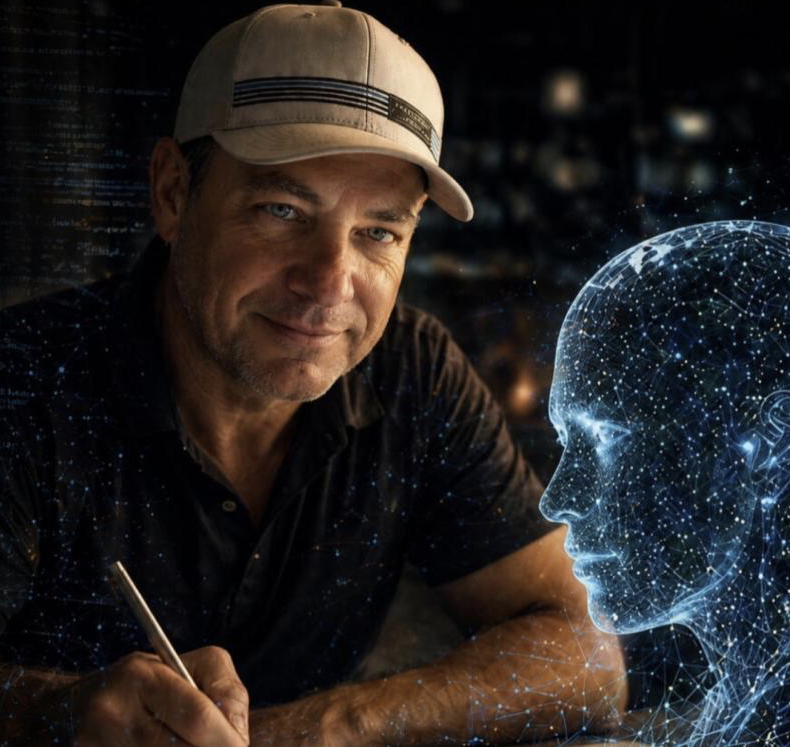
The conversation around artificial intelligence has been dominated for the past two years by questions about productivity, automation, jobs, and outputs. A newly published essay from entrepreneur and category pioneer Richard Aronow argues that conversation is missing the bigger story.
Titled "We Are the Last Humans to Think Alone," with the subtitle "A new species has been born. And it's us," the essay frames the current AI era not as a technological shift but as a cognitive one. The central argument is that AI is the first technology in human history that does not merely extend human capability, but participates in the formation of human thought itself.
"For centuries, human thought happened inside biological minds alone," Aronow writes. "Tools extended human capability, but they did not participate in thought itself. A calculator accelerated arithmetic. A search engine retrieved information. Neither joined the cognitive process. Artificial intelligence is different."
The essay describes what Aronow calls cognitive partnership: not consciousness, not sentience, but a feedback loop between a person and an AI system in which a thought appears that neither participant may have arrived at independently. The essay argues that this loop is now happening inside ordinary life, among students, doctors, founders, writers, and teenagers, and that civilization is adapting to it faster than it is recognizing it.
Aronow has said the essay began with a personal observation about his own use of AI. He noticed that he had stopped using the systems to find answers and had started using them to figure out what he thought. That subtle shift, he has said, became one of the foundations of the broader thesis. Rather than asking an AI system what to do, he was using it to clarify what he actually believed, drawing on the back-and-forth process the essay describes as cognitive partnership.
Aronow's perspective draws on a three-decade career identifying emerging categories before they reached mainstream visibility. He has been involved in early consumer wellness, early online education, and most recently in observing pattern formation in artificial intelligence and biotechnology. The essay applies that pattern-recognition lens to the AI moment, arguing that the most significant transformation underway is one that is hiding in plain sight.
A central claim in the essay is that "the transition arrived as convenience." Rather than announcing itself as a technological revolution, AI has entered daily life through faster emails, clearer sentences, better search results, and incremental help with everyday tasks. Aronow argues that this quiet entry is part of why the scale of the shift has been so widely underestimated.
The essay also explores how AI is reshaping education and the definition of intelligence itself. It argues that civilizations have historically responded to powerful new tools by redefining what counts as expertise rather than by abandoning intelligence. The people who thrive in the next era, the essay suggests, may not be those who memorize the most information but those who ask the best questions, recognize patterns earliest, and combine intuition, ethics, and machine collaboration into new forms of thinking.
Aronow has spent the past several years observing AI adoption from inside the broader entrepreneurial and investor communities. His pattern-recognition framework, developed across multiple market cycles, focuses on identifying the conditions under which new categories begin moving from the margins toward mainstream adoption. The essay applies that framework to AI not as a category to invest in, but as a force quietly reshaping the architecture of human thought.
"We Are the Last Humans to Think Alone" is published in full and available for public reading. Richard Aronow's broader work focuses on early signals across emerging sectors including artificial intelligence, biotechnology, and adjacent fields.
Contact:
Richard Aronow
Website: https://richardaronow.com
LinkedIn: https://www.linkedin.com/in/richard-aronow-6a66052b6
Instagram: https://www.instagram.com/richaronow/